Monday, 14 March 2016

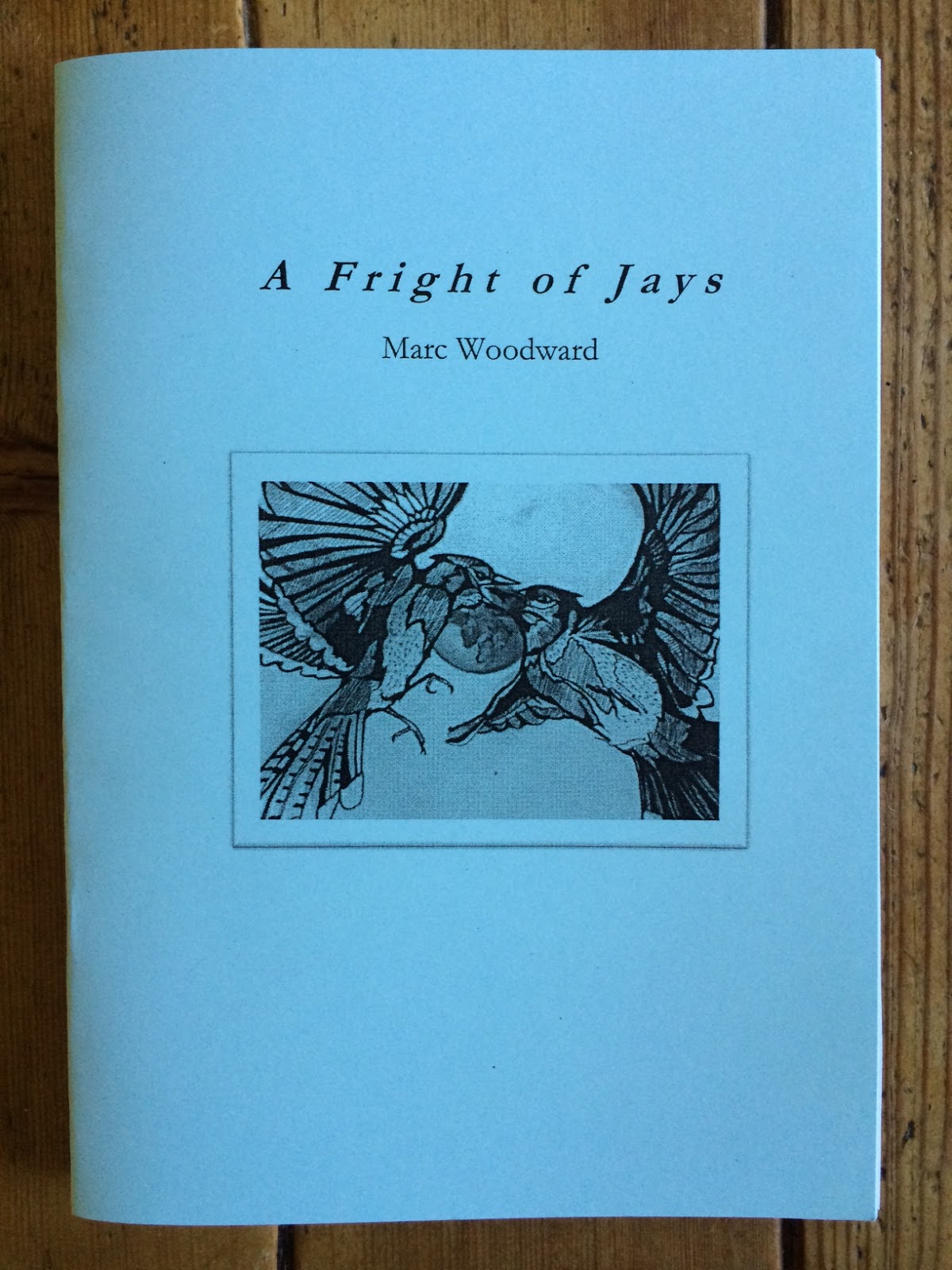
A Fright of Jays review

Delighted with this review by Simon Zonenblick at Sabotage Reviews.

Excerpt:

Poems about suicide, liberation, the bizarre destruction of a mobile phone in an apparently pre-meditated, insular revolution against technology, and the impact of humanity on the natural world, are somehow packaged neatly into this short, succinct, high quality chapbook, whose author achieves a level of observational exactitude, empathy, and at times, quite frankly, psychological menace, which many would fail to muster in a full-length collection.

The full review is here:

Monday, 21 December 2015

When Joe went out late


to shut away the poultry
after weeks of rain
he knew where the pony was
by the sound of its hooves
sucking in the mud.

Foxes still kill in downpours.
Maybe they keep closer
to the bones of the hedge
or loiter below hollies,
but they're always watching.
Hungry as December dark.

The hens were in and roosting,
dry enough in their houses.
He let the hatches drop
and turned towards the paddock.

Four days before Christmas
and he'd have preferred ice
to this unceasing rain.
The track would be flooded
down by the bridge,
the damp wall in the hall
coughing salt from flaking plaster.

He found the pony and together
the two squelched back to the stable.

If there were still stars
he hadn't seen them for many nights.
He'd laid off his shepherd
and couldn't think of
a wise man in those parts.

Should the Angel of the Lord come down
Glad tidings! Glad tidings!
he'd tell the twinkle to fuck right off.
And take the bloody weather with it.


First published at Your One Phone Call 6/6/2016


Tuesday, 22 September 2015

'A Fright Of Jays' review


Flattered by the following review in Canto Poetry magazine 21/9/15:

http://www.cantopoetry.co.uk/reviews-and-recommendations/#http:/andybrown5.wix.com/maquette#!publications/cnec

Marc Woodward:  A Fright of Jays
Maquette Press, 2015
£4.00     16pp
This chapbook by Marc Woodward invites the reader into a dark rurality. These are beautifully crafted poems, interweaving ideas of freedom, constraint and expiation, in a depiction of the pastoral that, as a fellow Devon inhabitant, I found simultaneously very recognisable and strangely defamiliarised. Death is dealt in almost every poem, and a walk in the countryside is a dangerous undertaking – the landscape holds darknesses, and not just those of the night.
The first poem, ‘Eel Catching’, takes us into a double darkness where ‘midnight fog […] whispers from the river mouth/the fetid smell of marsh decay’ and obscures the moon and stars. All seems held in stasis – until the eels come. ‘Sliding through underwater grass, current tracers in the blind depth’, the eels are ominous, precursors of something inexplicit but threatening. When the speaker catches one, ‘thrashing fiercely in the torchlight/ as if in tongues before the priest’, we start to believe that some kind of mystical sacrifice is going to take place. But when he does ‘the act’ on his own ‘back door step’, that liminal place between wilderness and civilisation, there is ‘so much dark blood, like thick red oil’, that the killing has become an obscene contamination – the blood that will not wash off the murderer’s hands, and an industrial pollutant that poisons the earth.
These poems are rooted in very real places, and this enables them to bear their cargo of metaphor with ease. In ‘Beyond Broadwoodwidger’, the reader is asked to imagine being stranded in the rural night, a night which is both meticulously observed and metaphorically freighted: here is ‘a justice of darkness’, ‘the weight of condensation/on a vast ocean of bending blades’, where ‘there is nothing to save you’. Do you lie down and let ‘this wet ditch/ […] be your decomposing place?’
This question is answered, in a way, in the next poem, ‘Crisis’. Here the speaker does indeed lie down upon the ground, after yet another act of violence – this time against his mobile phone and all that it signifies. And signification is part of the problem; he sees too much. He says ‘If I could drive blindfold I could go/ …where all the signs are free of symbols’. But he can’t escape that way, so he has to go home and free these particular signs from their symbols by using lies.
One of the things so enjoyable about Woodward's collection is the way in which the poems interact with each other. ‘The Crossing’, in which the speaker steals a dog from a cramped backyard and releases it ‘ten miles from town’ inverts the capture of ‘Eel Catching’. In a later poem, ‘Revival’, the speaker revives a lizard he has found frozen ‘at the red mud edge of a Devon lane’, a place that echoes and refashions the eel-bloodied doorstep.
The idea of escape is a thread running throughout these poems. The stolen dog might or might not survive, but at least it has escaped (unlike the speaker in ‘Crisis’), and been given a freedom to be re-wilded and to ‘howl among the trees/ some ancient dog-breath song’. It is a vicarious escape for the poet, but also, perhaps, an atonement.
In the final poem ‘Sing of the Mountain’ we are, however, returned to imprisonment. The countryside is dark and irresistible, and, having travelled their hard journey, ‘the children of the mountain are tied,/ twisted in bindweed, creeper and ivy’. And, of course, ‘then there’s the wolf-owl night’.
This is a collection which concedes that you can’t escape your own landscape, external or internal, but that you can at least sing, even if only of ‘tangled isolation, / dog-in-the-thicket thoughts’. These are poems that sing in the dark, of darkness.

(Sally Douglas read English and European Literature at Warwick University. She lives in Devon. Poems and short stories have appeared in magazines such as Smiths Knoll, The Rialto, Envoi, Orbis and Interpreter’s House, and in anthologies. Her first poetry collection, Candling the Eggs, won the Cinnamon Press 2009 Poetry Award.)


Tuesday, 9 June 2015

A Fright Of Jays


I'm delighted to have my chapbook A Fright Of Jays just published by Maquette Press.
It's a small collection of my darker bucolic, lyric poetry.

Some new, some older ones reworked. The poems included aren't on the blog here (although several have been previously, albeit in earlier rougher versions) - so if you want to see them you'll need to drop in on Maquette's website and order a copy!

Which at £4 incl p&p won't break your bank and will support an excellent small press producing collections of high quality writing (*ahem, clears throat*).

http://andybrown5.wix.com/maquette


Thursday, 11 September 2014

Cradling the moon


In this photo of you watching on deck
sailing across the Ionian Sea, 
you're cradling the low moon in your hands.

Just like some mermaid from mythology
holding Selene the 'rich tressed' deity,
in this photo of you watching on deck.

So far away, so young - friends say to me:
"the world will be her oyster" - but I see
you cradling the low moon in your hands.

I'm full of pride for all you've grown to be
- as a Father loves his child breaking free -
in this photo of you watching on deck,

holding an orb of light so carefully,
as if a precious torch by which to see -
you're cradling the low moon in your hands.

I wish you tranquil waters, warm brandy,
friendly ports and a passage pirate free!
In this photo of you watching on deck -
you're shining with the low moon in your hands.


Tuesday, 10 June 2014

Adlestrop Revisited

The Poetry Society ran a feature to celebrate the centenary of Edward Thomas’s famous poem Adlestrop. I’m delighted to say they used this poem on their site with a link to a Soundcloud audio version.


A soldier walked through the Adlestrop lanes,
wild flowers sprang where he planted his feet.
He said it was good to be there again
and looked for the station, the train and a seat.

But unlike lost soldiers frozen in youth,
no places stay as we knew them before.
The station had closed, the trains went right through
- no soldiers listened for birds anymore.

Yet some things stay as they always have been:
the foxgloves wave high in the hedgerow;
with bindweed, buttercup, small celandine,
hawthorn, meadowsweet, haycock and willow.

And once where the railway's thunder and steam
drowned out on departure the small bird's song
- now in their arching cathedrals of green
they sing for that soldier loudly and long.


Reading here:

https://soundcloud.com/marc-woodward/adlestrop-revisited

Featured on the Poetry Society website page: 'Celebrating Adlestrop'
http://www.poetrysociety.org.uk/content/adlestrop/

Sunday, 26 January 2014

Heron


               Heron   

      Wing beat sloppy slow
      I watch a soft grey
        heron go
            gently over
                      my patio.

      With upright stance
      and spindly knees
        herons roost
          in high trees,
              harmoniously,
                   in heronries.

       When first light ruffles
      dove down morning dress
      they rise like wedding guests
      and go their separate ways,

           leaving little signs
          turned neatly round
              that simply say:

                Gone Fishing.
                    All day.


Editor's Pick/Featured Work at Poetrycircle.com 1/2014

Wednesday, 24 March 2010

Eel Catching

A midnight fog lays down the land;
sucks quietly on the ploughed field,
wetly kisses the upturned sod,
whispers from the river mouth
the fetid smell of marsh decay.
The moon and stars, obscured by mist
stare upon other worlds tonight.
Time passes with no sense of motion.
The Earth lies still - except for me,
by the river, waiting for eels.

Now into this brackish reach the tide is running.
Sliding through underwater grass,
current tracers in the blind depth,
I can almost sense them: the eels are coming...
The small bell on the rod end rings,
I strike and take a fat one on -
shiny with slime, a liquid figure of eight.
I haul it to the bank, blackest in the blackness,
thrashing fiercely in the torchlight,
as if in tongues before the priest.

Later, as I walk through the wet grass
knee high by the silent river,
the eel still twists in the plastic bag
flapping briskly at my side.
On the back door step I do the act.
So much dark blood, like thick red oil,
flowing out toward the ground.
Still the eel moves in defiance,
blood without and blood within,
this deathless, lifeless thing.


c. Marc Woodward
Front Page 'Featured Work' 3/2010 PoetryCircle.com
First published in Otter - New Devon Poetry

Wednesday, 21 October 2009

Pomegrenades

The old woman picked "Pomegrenades"
carefully holding the handle, securing the pin,
she placed them in her basket.
Gingerly avoiding the land mines,
she moved down to the salad garden. The rocket
launchers were growing tall: higher than last year's bazookas.
She heard a blackbird sing from somewhere within
the camouflage netting cast over the fruit cage.
The vine was heavy with bullets: ("Grapes Of Rage");
she must return with her trug and a magazine.
The nail bombs looked like artichokes -"Jerusalem"
it said on the tag: she placed one into a bag.
Looking at the sky she felt the dusk
cosseting in. She should pop to the shop
before it got dark. Light the fire, think about tea.
Leave the garden locked up securely.


c. Marc Woodward

Editors Pick at 'Poetrycircle.com' 12/2009
Published in 'Making Contact' poetry anthology, Ravenshead Press, 12/2012